
Trapezius (*Traps)
Back · Trunk
The trapezius is the large, flat, diamond-shaped muscle that covers the back of the neck and upper trunk, extending from the skull and vertebral column out to the shoulder girdle. It has an extensive origin from the medial third of the superior nuchal line, the external occipital protuberance, the nuchal ligament, and the spinous processes of C7 to T12, and it converges onto the lateral third of the clavicle, the acromion, and the spine of the scapula. Because its fibres run in three directions, it is best understood as three functional parts: the upper fibres elevate and upwardly rotate the scapula, the middle fibres retract it, and the lower fibres depress and assist upward rotation. Together with serratus anterior it produces the upward rotation needed to raise the arm overhead. It is supplied by the accessory nerve (CN XI), with proprioceptive fibres from C3 and C4. Because the accessory nerve runs superficially across the posterior triangle of the neck, it is at risk during lymph node biopsy, which can lead to shoulder drooping and weak elevation.
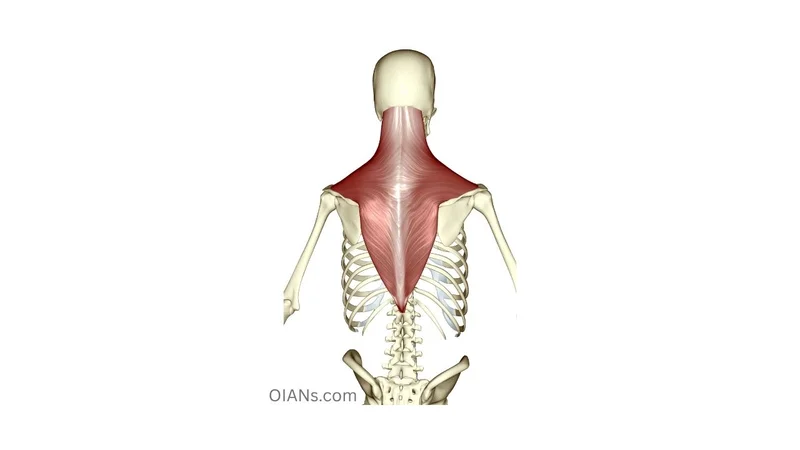
Origin, Insertion, Action & Nerve
Origin
Medial third of superior nuchal line, external occipital protuberance, nuchal ligament, spinous processes of C7–T12
Insertion
Lateral third of clavicle, acromion, and spine of scapula
Action
Upper: elevates and upwardly rotates scapula; Middle: retracts scapula; Lower: depresses and upwardly rotates scapula
Nerve
Accessory nerve (CN XI); proprioception via C3–C4
Attachments explained
The Trapezius (*Traps) is defined first by where it attaches. Its origin is the more fixed anchor, usually the proximal or more stable end that stays put during contraction, while its insertion is the more mobile point that is pulled toward the origin when the muscle shortens.
Origin
Medial third of superior nuchal line, external occipital protuberance, nuchal ligament, spinous processes of C7–T12
Insertion
Lateral third of clavicle, acromion, and spine of scapula
Action & function
When the Trapezius (*Traps) contracts, it produces the following movements: Upper: elevates and upwardly rotates scapula; Middle: retracts scapula; Lower: depresses and upwardly rotates scapula.
As part of the Back group of the Trunk, it works alongside neighbouring muscles to generate smooth, coordinated movement and to stabilise the structures it acts on.
Nerve supply & clinical relevance
The Trapezius (*Traps) receives its nerve supply from the Accessory nerve (CN XI); proprioception via C3–C4. This nerve carries fibres from spinal segment(s) C3, C4.
Because a muscle can only contract when its nerve is intact, injury to the Accessory nerve or to its spinal roots (C3, C4) can weaken or paralyse the Trapezius (*Traps), impairing the movements it normally produces (elevates and upwardly rotates scapula). This is why knowing the innervation is central to localising nerve lesions in clinical practice.
How to study the Trapezius (*Traps) (the OIANS method)
Divide the trapezius into upper, middle, and lower parts and reason from fibre direction rather than memorising a list. Descending fibres pull the scapula up and help rotate the glenoid upward, horizontal middle fibres pull it toward the midline, and ascending lower fibres pull it down. Picture shrugging, bracing the shoulders back, and pressing them down, and each part's action becomes intuitive.
Anchor the nerve with a clinical hook: the trapezius is one of the few muscles supplied by a cranial nerve, the accessory nerve (CN XI), which travels superficially through the posterior triangle. Remembering that this exposed course makes it vulnerable during neck surgery ties the innervation to a real consequence, drooping shoulder and weak scapular elevation, which is far stickier than the label alone.
Frequently asked questions
Where is the Trapezius (*Traps) located?
The Trapezius (*Traps) is a muscle of the Back group, located in the Trunk.
What is the origin of the Trapezius (*Traps)?
Medial third of superior nuchal line, external occipital protuberance, nuchal ligament, spinous processes of C7–T12
What is the insertion of the Trapezius (*Traps)?
Lateral third of clavicle, acromion, and spine of scapula
What movements does the Trapezius (*Traps) produce?
Upper: elevates and upwardly rotates scapula; Middle: retracts scapula; Lower: depresses and upwardly rotates scapula
What nerve supplies the Trapezius (*Traps)?
Accessory nerve (CN XI); proprioception via C3–C4
Is the Trapezius (*Traps) free to study in OIANS?
The Trapezius (*Traps) is always free to browse. Its full origin, insertion, action and nerve details are open to everyone in the Muscle Directory. Quiz and Flashcard practice for the Trunk is part of the one-time Lifetime upgrade, though; only the Upper Limb decks are free to test yourself on.
Related muscles
Study the Trapezius (*Traps)
Test yourself on Trunk muscles with interactive quizzes and flashcards in the free OIANS app.
Quiz yourself → Flashcards Open the OIANS app
Browsing is always free. A one-time Lifetime unlock adds every region's quizzes, flashcards, progress tracking and explore tools.