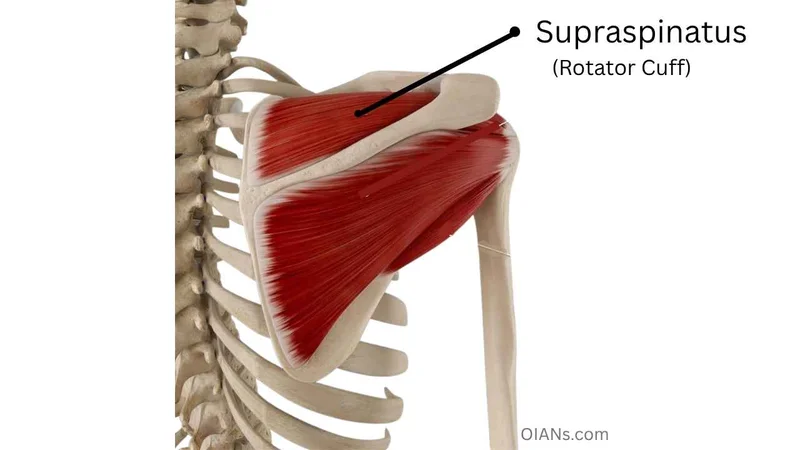
Supraspinatus (Rotator Cuff)
Shoulder & Scapula · Upper Limb
The supraspinatus is the uppermost of the four rotator cuff muscles, lying in the supraspinous fossa above the spine of the scapula. Its tendon passes beneath the acromion to reach the superior facet of the greater tubercle of the humerus, a cramped space that makes it especially vulnerable to wear. Functionally it initiates abduction of the arm through the first 15 degrees before the deltoid takes over, and throughout movement it pulls the head of the humerus into the glenoid cavity to keep the shoulder joint stable. It is innervated by the suprascapular nerve (C5, C6). The supraspinatus is the most frequently torn cuff muscle; clinically its integrity is tested with the empty can manoeuvre, and impingement of its tendon produces the characteristic painful arc of abduction.
Origin, Insertion, Action & Nerve
Origin
Supraspinous fossa of scapula
Insertion
Superior facet of greater tubercle of humerus
Action
Initiates abduction of arm (first 0–15°); stabilizes glenohumeral joint
Nerve
Suprascapular nerve (C5, C6)
Attachments explained
The Supraspinatus (Rotator Cuff) is defined first by where it attaches. Its origin is the more fixed anchor, usually the proximal or more stable end that stays put during contraction, while its insertion is the more mobile point that is pulled toward the origin when the muscle shortens.
Origin
Supraspinous fossa of scapula
Insertion
Superior facet of greater tubercle of humerus
Action & function
When the Supraspinatus (Rotator Cuff) contracts, it produces the following movements: Initiates abduction of arm (first 0–15°); stabilizes glenohumeral joint.
As part of the Shoulder & Scapula group of the Upper Limb, it works alongside neighbouring muscles to generate smooth, coordinated movement and to stabilise the structures it acts on.
Nerve supply & clinical relevance
The Supraspinatus (Rotator Cuff) receives its nerve supply from the Suprascapular nerve (C5, C6). This nerve carries fibres from spinal segment(s) C5, C6.
Because a muscle can only contract when its nerve is intact, injury to the Suprascapular nerve or to its spinal roots (C5, C6) can weaken or paralyse the Supraspinatus (Rotator Cuff), impairing the movements it normally produces (initiates abduction of arm (first 0–15°)). This is why knowing the innervation is central to localising nerve lesions in clinical practice.
How to study the Supraspinatus (Rotator Cuff) (the OIANS method)
Learn the supraspinatus as the muscle that gets abduction started. Picture it sitting in the fossa above the scapular spine and pulling the humeral head into the socket, which explains both its role in initiating the first few degrees of abduction and its constant stabilising duty as part of the cuff. Contrast it directly with the deltoid, which continues abduction once the supraspinatus has begun it.
Fix the clinical detail that makes this muscle memorable: its tendon runs through a tight subacromial space, so it is the cuff muscle most often torn and impinged. Link the empty can test and the painful arc to that anatomy, and remember it shares the suprascapular nerve (C5, C6) with infraspinatus, so one nerve lesion can weaken both.
Frequently asked questions
Where is the Supraspinatus (Rotator Cuff) located?
The Supraspinatus (Rotator Cuff) is a muscle of the Shoulder & Scapula group, located in the Upper Limb.
What is the origin of the Supraspinatus (Rotator Cuff)?
Supraspinous fossa of scapula
What is the insertion of the Supraspinatus (Rotator Cuff)?
Superior facet of greater tubercle of humerus
What movements does the Supraspinatus (Rotator Cuff) produce?
Initiates abduction of arm (first 0–15°); stabilizes glenohumeral joint
What nerve supplies the Supraspinatus (Rotator Cuff)?
Suprascapular nerve (C5, C6)
Is the Supraspinatus (Rotator Cuff) free to study in OIANS?
Yes. The Supraspinatus (Rotator Cuff) is free in OIANS: its full origin, insertion, action and nerve details are open to everyone in the Muscle Directory, and because it belongs to the Upper Limb it is also covered by the free Quiz and Flashcard decks. The other regions, the "All Muscles" deck, and the Progress and Explore tools are unlocked with a one-time Lifetime purchase.
Related muscles
Study the Supraspinatus (Rotator Cuff)
Test yourself on Upper Limb muscles with interactive quizzes and flashcards in the free OIANS app.
Quiz yourself → Flashcards Open the OIANS app
Browsing is always free. A one-time Lifetime unlock adds every region's quizzes, flashcards, progress tracking and explore tools.