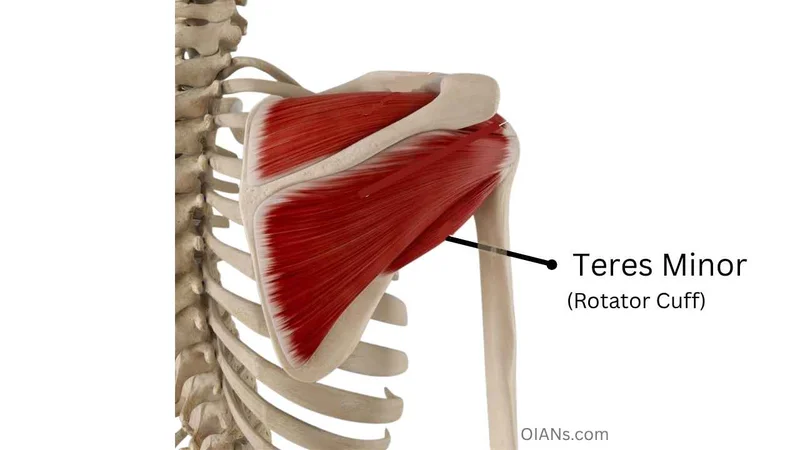
Teres Minor (Rotator Cuff)
Shoulder & Scapula · Upper Limb
The teres minor is the smallest of the rotator cuff muscles and the most inferior of the posterior cuff group. It arises from the upper part of the lateral border of the scapula and inserts onto the inferior facet of the greater tubercle of the humerus, just below infraspinatus. Working alongside infraspinatus, it laterally (externally) rotates the arm and reinforces the posterior aspect of the glenohumeral joint, keeping the humeral head centred during movement. Unlike the other three cuff muscles, teres minor is innervated by the axillary nerve (C5, C6) rather than the suprascapular nerve.
Origin, Insertion, Action & Nerve
Origin
Superior part of lateral border of scapula
Insertion
Inferior facet of greater tubercle of humerus
Action
Lateral (external) rotation of arm; stabilizes glenohumeral joint
Nerve
Axillary nerve (C5, C6)
Attachments explained
The Teres Minor (Rotator Cuff) is defined first by where it attaches. Its origin is the more fixed anchor, usually the proximal or more stable end that stays put during contraction, while its insertion is the more mobile point that is pulled toward the origin when the muscle shortens.
Origin
Superior part of lateral border of scapula
Insertion
Inferior facet of greater tubercle of humerus
Action & function
When the Teres Minor (Rotator Cuff) contracts, it produces the following movements: Lateral (external) rotation of arm; stabilizes glenohumeral joint.
As part of the Shoulder & Scapula group of the Upper Limb, it works alongside neighbouring muscles to generate smooth, coordinated movement and to stabilise the structures it acts on.
Nerve supply & clinical relevance
The Teres Minor (Rotator Cuff) receives its nerve supply from the Axillary nerve (C5, C6). This nerve carries fibres from spinal segment(s) C5, C6.
Because a muscle can only contract when its nerve is intact, injury to the Axillary nerve or to its spinal roots (C5, C6) can weaken or paralyse the Teres Minor (Rotator Cuff), impairing the movements it normally produces (lateral (external) rotation of arm). This is why knowing the innervation is central to localising nerve lesions in clinical practice.
How to study the Teres Minor (Rotator Cuff) (the OIANS method)
Anchor the teres minor next to infraspinatus, since the two share both a location on the back of the shoulder and the action of lateral rotation. Picture it as the small strip running from the lateral border of the scapula up to the lowest facet of the greater tubercle, and its external rotation function falls out of that geometry.
The single fact worth memorising here is the exception: of the four cuff muscles, teres minor alone is supplied by the axillary nerve. Pairing it in your mind with the deltoid, the other axillary-nerve muscle, gives you a two-for-one recall hook and keeps it distinct from infraspinatus.
Frequently asked questions
Where is the Teres Minor (Rotator Cuff) located?
The Teres Minor (Rotator Cuff) is a muscle of the Shoulder & Scapula group, located in the Upper Limb.
What is the origin of the Teres Minor (Rotator Cuff)?
Superior part of lateral border of scapula
What is the insertion of the Teres Minor (Rotator Cuff)?
Inferior facet of greater tubercle of humerus
What movements does the Teres Minor (Rotator Cuff) produce?
Lateral (external) rotation of arm; stabilizes glenohumeral joint
What nerve supplies the Teres Minor (Rotator Cuff)?
Axillary nerve (C5, C6)
Is the Teres Minor (Rotator Cuff) free to study in OIANS?
Yes. The Teres Minor (Rotator Cuff) is free in OIANS: its full origin, insertion, action and nerve details are open to everyone in the Muscle Directory, and because it belongs to the Upper Limb it is also covered by the free Quiz and Flashcard decks. The other regions, the "All Muscles" deck, and the Progress and Explore tools are unlocked with a one-time Lifetime purchase.
Related muscles
Study the Teres Minor (Rotator Cuff)
Test yourself on Upper Limb muscles with interactive quizzes and flashcards in the free OIANS app.
Quiz yourself → Flashcards Open the OIANS app
Browsing is always free. A one-time Lifetime unlock adds every region's quizzes, flashcards, progress tracking and explore tools.